The Big 6 Just Got Their PCAOB Report Cards. Here's What the Numbers Say.
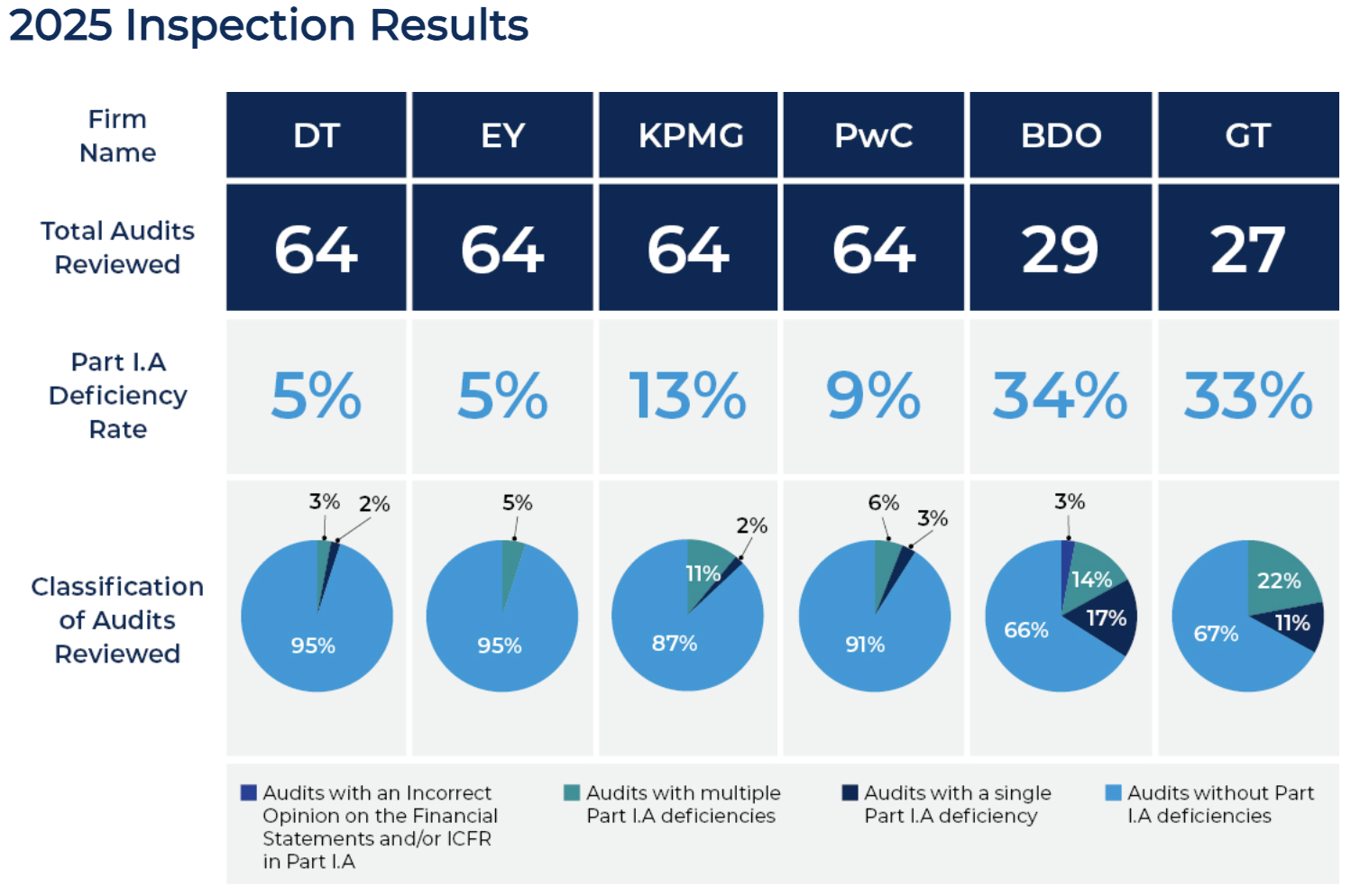
Source: PCAOB, 2025 Inspection Results — pcaobus.org
On August 13, 2026, the PCAOB released its annual inspection reports for the six largest audit firms. The headline: improvement across the board — but the gap between the top performers and everyone else is still significant.
For fund managers, financial institutions, and valuation teams, these results aren't just industry news. They're a signal about the direction of audit scrutiny and what it takes to hold up under it.
The Numbers, Firm by Firm
All six firms showed improvement over their 2024 results. Here's where each one landed:
Ernst & Young had the most dramatic turnaround. Three of 64 audits reviewed in 2025 were flagged with significant deficiencies — a Part I.A deficiency rate of less than 5%, down from 28% in 2024. EY called it the best inspection result in the firm's history, attributing the 23-percentage-point improvement to a $1 billion investment in technology, AI, advanced analytics, and talent. Deficiencies that remained were primarily related to testing of revenue, income taxes, and insurance-related assets and liabilities.
Deloitte also came in at under 5%, with three of 64 audits flagged. That's down from a 14% rate in 2024. Remaining deficiencies related to testing of controls over revenue.
PricewaterhouseCoopers posted a 9% Part I.A deficiency rate — six of 64 audits flagged — down from 16% in 2024. Deficiencies were primarily related to testing of controls over revenue, related accounts, and long-lived assets.
KPMG came in at 12.5%, with eight of 64 audits flagged, down significantly from 20% in 2024. Identified deficiencies primarily related to inventory and other assets.
Grant Thornton posted a 33% rate — nine of 27 audits — down from 48% in 2024. Deficiencies related to revenue, inventory, and investment securities.
BDO USA came in at approximately 34%, with 10 of 29 audits flagged, down from 60% in 2024. Deficiencies related to revenue, goodwill and intangible assets, and long-lived assets.
The Pattern Behind the Progress
A few things stand out across the results.
First, the firms that improved the most were the ones that invested most directly in process — not just training, but systems, technology, and methodology. EY's $1 billion investment in AI and analytics is the clearest example, but the pattern holds across the group.
Second, revenue-related deficiencies remain the most common thread. Testing of controls over revenue appeared in the deficiency findings at PwC, Deloitte, EY, Grant Thornton, and BDO. That suggests revenue recognition and the controls supporting it remain a persistent challenge, even as overall rates decline.
Third, the gap between the Big Four and mid-tier firms is still meaningful. While EY and Deloitte landed at under 5%, Grant Thornton and BDO were both above 30%. Progress is real — but it's not uniform.
The PCAOB Is Changing How It Inspects
Perhaps more significant than any single firm's result is what the PCAOB said about where inspections are heading.
PCAOB Chair Demetrios Logothetis announced plans to overhaul the inspection program to focus on firms' overall systems of quality control rather than deficiencies at the individual engagement level.
"When we inspect at the quality control level, we are not only looking at whether an audit was performed appropriately," Logothetis said. "We are evaluating whether the system — the governance, culture, risk assessment, monitoring, and remediation — is functioning in a way that consistently produces high-quality audits."
That's a fundamental shift. It aligns directly with QC 1000, the new PCAOB quality control standard taking effect December 15, 2026 — and it signals that the bar isn't just about individual findings anymore. It's about whether your entire system is built to prevent them.
What This Means for Valuation Teams
The inspection results for the Big 6 are specific to those firms, but the implications extend further. As audit firms strengthen their processes and the PCAOB raises its expectations, the quality of valuation support and documentation that auditors require from their clients rises alongside it.
Firms trending in the right direction share a common trait: stronger evidence, more rigorous methodology, and documentation that holds up when someone looks closely. That's not an audit-season exercise. It's a year-round standard.
At Harvest, we've been helping auditors, financial institutions, and valuation teams meet exactly that standard for more than 30 years — through independent pricing, valuation advisory, and documentation built for scrutiny. harvestinvestments.com