Private Credit’s Valuation Problem: What Happens When the Market Cannot Agree?
Private credit has grown into a significant part of the global financial system. But as the asset class expands, one question is becoming increasingly difficult to ignore:
What is a private loan actually worth when there is no active market to establish its price?
Unlike publicly traded securities, private credit instruments typically do not have continuously quoted prices. Transactions may be infrequent, borrower information may be limited, and the terms of each loan can differ considerably. Valuation therefore relies on a combination of available market evidence, financial analysis, modeling, and professional judgment.
That does not mean one valuation is necessarily correct and another is wrong. However, when market participants reach materially different conclusions about similar assets - or even the same underlying asset - the differences can affect investor confidence, financial reporting, risk management, and liquidity decisions.
Why private credit valuations can diverge
Private credit instruments are commonly valued using assumptions that are not directly observable in an active market. These may include:
Market yields and credit spreads
Probability of default
Expected recovery rates
Borrower financial performance
Enterprise value and EBITDA multiples
Loan seniority and collateral coverage
Covenant compliance
Expected cash flows
Remaining maturity and refinancing risk
Comparable public or private transactions
Many private loans are classified as Level 3 assets under the fair value hierarchy because their valuations depend significantly on unobservable inputs. Under ASC 820, unobservable inputs are used when relevant observable inputs are unavailable. Those inputs should reflect the assumptions market participants would use to price the asset or liability at the measurement date.[1]
This requires firms to make informed judgments about how current market participants would evaluate an instrument - not simply rely on the original transaction price or an internally preferred value.
Recent public filings demonstrate how widely valuation assumptions can vary by investment. For example, a March 2026 private-credit filing reported market yields ranging from 6.4% to 27% for senior debt and first-lien notes, depending on the underlying instrument.[2]
Even relatively small differences in a selected yield, default expectation, financial projection, or comparable-company multiple can produce meaningful differences in fair value.
The market is beginning to test those assumptions
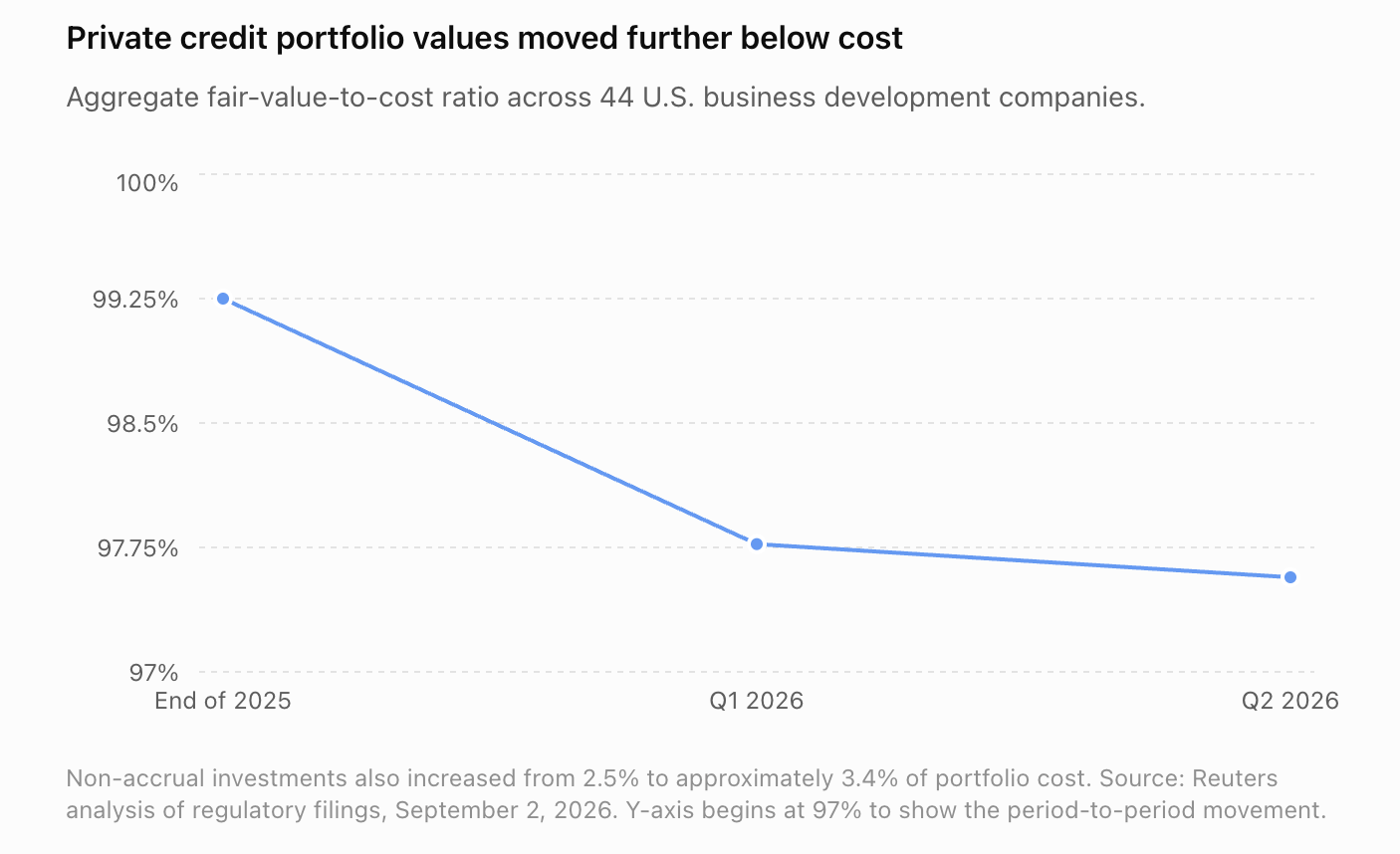
Across 44 U.S. BDCs reviewed by Reuters, aggregate portfolio fair value moved further below reported cost during the first half of 2026. The change reflects both broader market repricing and borrower-specific stress.
Valuation differences become more visible when market conditions change.
A Reuters analysis of filings from 44 U.S. business development companies found that the aggregate fair-value-to-cost ratio declined from 99.25% at the end of 2025 to 97.57% by the end of the second quarter of 2026. The analysis also found that non-accrual investments increased to approximately 3.4% of portfolio cost, compared with 2.5% at the end of 2025.
The markdowns were not distributed evenly. Some reflected broader changes in credit spreads, while others were driven by borrower-specific deterioration.
Software-related loans received particular attention. Data cited by Reuters indicated that 81% of software loans had been marked down during the year, compared with 40% of loans outside the sector. In several major BDC portfolios, a relatively small number of investments accounted for a significant portion of unrealized losses.[3]
This distinction matters.
A decline caused by market-wide spread movement is different from one caused by weakening borrower fundamentals, a covenant breach, missed payments, deteriorating collateral coverage, or reduced refinancing prospects. A credible valuation process must identify and document the factors driving a change rather than treating every markdown as the same type of event.
When the market disagrees, confidence becomes the real issue
Valuation dispersion does more than create different numbers on financial statements. It can make it harder for stakeholders to understand the actual risk and performance of an investment.
The issue is receiving increased attention. In June 2026, the U.S. Attorney for the Southern District of New York said federal prosecutors were examining valuation practices in private markets, including situations in which different institutions assigned different values to the same asset. Concerns included transparency, consistency, and potential conflicts when management fees are connected to reported valuations.
S&P Global Market Intelligence reports that approximately two-thirds of the private credit market is “unobservable.” It has also identified valuation discrepancies, uneven disclosures, and inconsistent methodologies as obstacles to comparing managers, funds, and strategies.
When valuation practices are inconsistent, several questions emerge:
Are reported returns comparable across funds?
Does NAV reflect current market conditions?
Are changes in borrower risk being recognized promptly?
Are similar instruments being evaluated consistently?
Can the assumptions behind a valuation withstand independent review?
Would another market participant reach a reasonably similar conclusion using the same information?
A valuation does not need to match every other market participant’s estimate. Private assets contain legitimate uncertainty, and reasonable professionals can reach different conclusions.
The concern arises when those differences cannot be clearly explained.
A defensible valuation is more than a number
In an opaque market, the strongest valuation is not necessarily the highest, lowest, or most conservative estimate. It is the conclusion that can be supported by a consistent process and relevant evidence.
A defensible private credit valuation should demonstrate:
Relevant market inputs
The valuation should incorporate current information about interest rates, credit spreads, comparable instruments, transaction activity, industry conditions, and the borrower’s specific risk profile.
Instrument-level analysis
The terms and risks of the individual investment matter. Seniority, collateral, covenants, payment structure, maturity, prepayment provisions, and other contractual features can all affect value.
Borrower-specific fundamentals
Market movement should not be used as a substitute for analyzing the borrower. Revenue, profitability, liquidity, leverage, debt-service capacity, and recent operating performance remain essential.
Consistent methodology
Firms should be able to explain why a particular methodology was selected, how it was applied, and whether it remains appropriate as market and borrower conditions change.
Consistency does not mean assumptions must remain static. It means changes should be intentional, supportable, and documented.
Clear documentation
Supporting documentation should identify the data, assumptions, methodologies, judgments, and market developments behind the final conclusion.
That record becomes especially important when responding to auditors, valuation committees, investors, regulators, and other stakeholders.
Independent challenge
An independent perspective can help identify stale assumptions, inconsistencies, unsupported inputs, or emerging market information that may not be reflected in an internally generated mark.
Independence does not eliminate judgment - it strengthens the process
Independent valuation is sometimes treated as a mechanism for producing a second number. Its more important function is to introduce structured challenge into the valuation process.
An independent valuation can help firms assess whether:
Selected inputs reflect current market conditions
Borrower-specific developments have been incorporated appropriately
Comparable instruments are genuinely comparable
Methodologies are being applied consistently
Changes from previous periods are adequately explained
The final valuation falls within a supportable range
The goal is not to remove judgment from private credit valuation. That would be impossible in a market defined by limited observable data.
The goal is to make that judgment more transparent, consistent, and defensible.
Building confidence when the market cannot provide consensus
Private credit’s valuation challenge will not disappear as the market grows. Continued growth may increase the need for stronger valuation infrastructure as investors, financial institutions, auditors, and regulators seek to better understand the risks behind reported values.
When the market cannot provide a clear consensus price, firms need more than an unsupported estimate. They need a repeatable process grounded in relevant market information, instrument-level analysis, documented inputs and assumptions, transparent methodologies, and experienced valuation judgment.
Harvest provides independent and transparent valuations for simple to hard-to-price financial instruments. Through specialized loan valuations, customized valuation advisory services, clear reporting, and the myPricingDesk platform, Harvest helps financial reporting professionals navigate complex valuation requirements with greater clarity and confidence.[6]
Need an independent valuation for a specialized loan or another hard-to-price financial instrument? Contact Harvest Investments to learn how its valuation professionals can support your team.
Sources
Financial Accounting Standards Board, ASC 820 guidance regarding Level 3 and unobservable inputs
Reuters, “US private credit firms mark down more loans,” September 2, 2026
S&P Global Market Intelligence, “Five Trends Shaping the Future of Private Credit,” August 4, 2026
Harvest Investments, Financial Instrument Valuation Solutions